
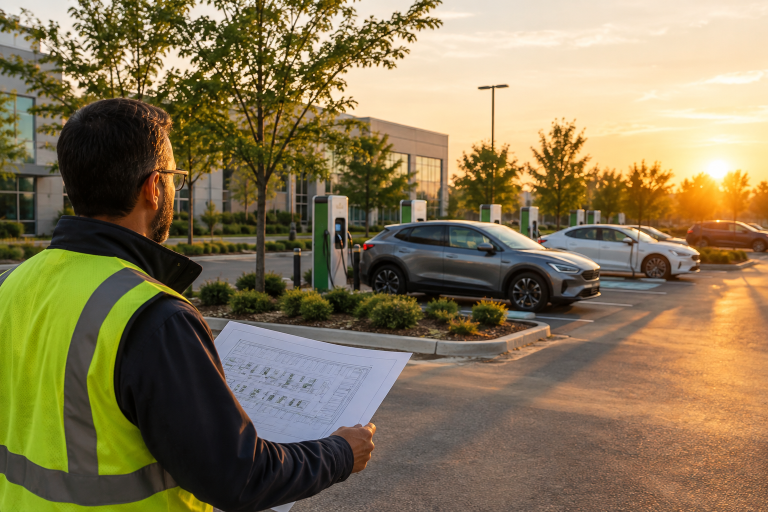
Key Takeaways
- Start with parking behavior and driver needs, not a preferred charger count.
- Match charging speed to the amount of time vehicles are likely to remain parked.
- Review electrical capacity and utility requirements before ordering equipment.
- Budget for design, trenching, permits, networking, maintenance, and future expansion.
- Plan the operating model, payment rules, support process, and accessibility from the beginning.
Commercial EV charging works best when it is treated as a property-planning project rather than a simple equipment purchase. Before comparing charger models, owners and facility managers should understand who will park on-site, how long they will stay, what the building can support, and how the program will operate. For equipment options suited to different property types, property teams can explore Blink Charging’s commercial lineup as they develop a broader site plan.
The right approach can look very different at an office, apartment community, hotel, grocery store, medical campus, or fleet depot. A successful installation balances driver convenience with electrical capacity, construction realities, maintenance responsibilities, and room for future demand.
Why EV Charging Requires A Property-Level Plan
A charger may be visible to drivers, but the surrounding infrastructure determines whether it is practical to install and operate. Parking duration, tenant schedules, customer traffic, fleet departure times, electrical demand, and utility service all influence the right design. For example, a workplace may have vehicles parked for most of the day, while a convenience-oriented location may serve drivers making much shorter stops.
Early planning also prevents expensive changes later. Running conduit, reserving panel space, and identifying future charging areas during an initial construction project can be easier than reopening pavement after the first chargers are installed. The U.S. Department of Energy’s guidance on procurement and installation similarly identifies equipment, installation, maintenance, permitting, and accessibility as important parts of charging infrastructure development.
Step 1: Define Who Will Use The Chargers
Identify the primary users before selecting equipment. Employees, residents, hotel guests, customers, visitors, service vehicles, and public drivers may have very different expectations. A workplace can survey employees or tenants to understand likely demand. A fleet operator should instead focus on route lengths, vehicle dwell times, battery needs, and required departure schedules.
- Workplaces: Employees may charge during a long workday.
- Multifamily properties: Residents may need regular overnight access.
- Hotels: Guests may be charged for overnight stays.
- Retail and restaurants: Customers may need short- to medium-length sessions.
- Fleets: Vehicles may need to be charged predictably before the next shift.
Step 2: Match Charging Speed To Parking Time
Level 2 charging is commonly suited to locations where vehicles remain parked for several hours, including workplaces, apartments, hotels, and campuses. DC fast charging is better suited to locations where drivers need to add energy during a short stop, such as travel corridors, convenience sites, or time-sensitive fleet operations.
Faster is not automatically better. Higher-power equipment can require larger electrical infrastructure, more complex construction, and greater demand on the site. A mixed-use property may benefit from a combination of Level 2 ports for longer stays and Level 3 ports for faster charging for drivers with limited time.
Step 3: Review Electrical Capacity Before Ordering Equipment
An electrician or qualified engineering team should review the existing service, main distribution equipment, panels, transformers, available circuits, conductor paths, and building load. The review should also consider when the building reaches its highest demand and whether charging will overlap with that period.
- Document current utility service and building load information.
- Identify available capacity in panels and switchgear.
- Determine whether a transformer, panel, or service upgrade may be needed.
- Ask the utility about its process, design requirements, and anticipated work.
- Evaluate managed charging if simultaneous charging at full capacity would exceed site capacity.
Step 4: Build A Complete Project Budget
The charger purchase price is only one cost category. A realistic budget should include electrical design, civil work, trenching, conduit, paving restoration, permits, inspections, utility fees, networking, payment systems, signage, maintenance, and repairs. Accessibility improvements and protective equipment, such as bollards, may also be needed.
Create one budget for the initial installation and another for future expansion. This helps owners compare a smaller launch with a design that preserves pathways for additional ports later.
Step 5: Design A Driver-Friendly Site Layout
Chargers should be easy to find, safe to approach, well-lit, and positioned to avoid unnecessary cable conflicts with walking areas. Review vehicle turning space, drainage, weather exposure, security, and proximity to practical electrical routes. A hotel may place chargers near overnight guest parking, while a grocery store may choose visible spaces near the entrance.
Accessibility should be part of the layout discussion from the first drawing. The U.S. Access Board’s accessible charging station design recommendations address elements such as accessible routes, clear ground space, operable parts, charging cables, and user interfaces. Local requirements can vary, so project teams should confirm applicable rules with the authority having jurisdiction.
Step 6: Plan For Load Management And Future Growth
Managed charging can coordinate power across multiple vehicles rather than allowing every port to draw its maximum output at once. Depending on the system and site goals, charging may be scheduled for lower-demand periods, prioritized for vehicles leaving earlier, or shared among connected vehicles.
During the first installation, consider adding spare conduit, reserving space in the electrical room, and leaving space in the parking layout for later equipment. Usage data from the first phase can guide decisions about where and when to add more ports.
Step 7: Choose An Operating Model
Property owners should decide who owns the equipment, set access rules, collect payment, monitor performance, and respond to driver issues. In a property-managed model, the owner retains direct control. In a third-party model, a provider may handle software, payments, or support. A shared model can divide responsibilities between the owner, tenants, fleet operator, or service provider.
Connected charging equipment can provide station status, energy-use records, session history, revenue reporting, remote diagnostics, and driver notifications. These capabilities are useful only when someone is clearly responsible for reviewing alerts and arranging service when equipment is offline.
Permits, Construction, And Common Mistakes
Begin permit and utility coordination early, then finalize equipment after the electrical design is stable. Before opening the chargers, test the network connection, payment settings, access controls, signage, safety features, and support contacts.
Common mistakes include choosing chargers before studying parking patterns, overlooking existing electrical load, budgeting only for hardware, placing equipment where drivers cannot easily use it, and failing to reserve space for growth. A practical plan addresses the full ownership cycle, from the first site assessment through long-term operation and expansion.
