

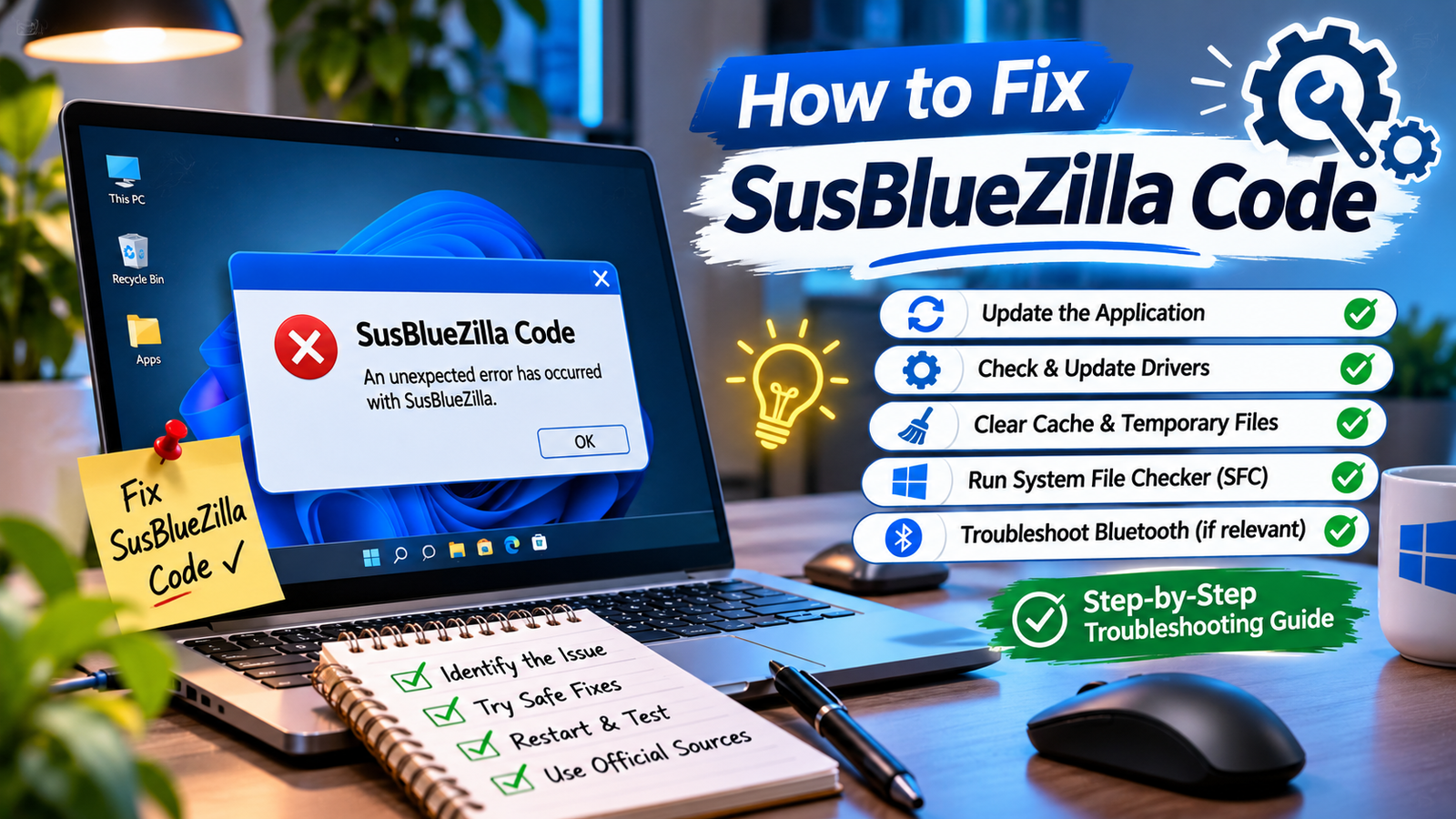
how to fix susbluezilla code is a troubleshooting search phrase used by people who have encountered an unfamiliar software message, application crash, installation problem, or connectivity issue. Before changing Windows settings, it is important to understand that SusBlueZilla is not documented by Microsoft as a standard Windows error code. Online pages describe it in different ways, so the phrase alone does not identify one confirmed cause.
This guide explains a careful way to investigate the message, isolate the affected application, and try safe repairs that match the symptoms. The phrase how to fix susbluezilla code may be associated with Bluetooth, outdated drivers, corrupted application files, or update conflicts in online troubleshooting discussions, but those possibilities should not be treated as a diagnosis. Start with the exact message displayed on your device and the application that produced it.
1. Understand What the SusBlueZilla Message Actually Means
The first step in how to fix susbluezilla code is to identify where the wording appears. Is it inside a particular program, in a Windows notification, on a website, or in an installer? These situations are different and should not receive the same repair.
The phrase is not established as an official Windows error name in the Microsoft documentation reviewed for this guide. Some third-party articles associate it with Bluetooth or driver problems, while others describe application launch failures, update conflicts, cache issues, or missing runtime components. This inconsistency means how to fix susbluezilla code should begin with investigation rather than assumptions.
Write down the complete message, any separate numeric error code, the program name, and the time it appeared. If possible, take a screenshot. Note what happened immediately beforehand, such as a software update, new installation, driver change, or connection attempt. For how to fix susbluezilla code, begin with the exact message.
If you only saw the phrase in an online article or advertisement and your computer is working normally, you may not have a device problem to repair. Do not download a tool just because a webpage tells you to.
2. Common Situations That May Be Behind the Message
There is no single verified cause for every report using this phrase. However, several ordinary software problems can produce confusing messages or similar symptoms.
- Incomplete updates: An update may stop midway or leave old and new application files that do not work together.
- Damaged application files: A program may fail to launch if important files are missing or corrupted.
- Cache conflicts: Temporary data from an older version may not work correctly after an update.
- Driver issues: Outdated or incompatible drivers can affect connected hardware, including Bluetooth devices.
- Extension or plugin conflicts: Add-ons may not support the current application version.
- Missing dependencies: Some applications require specific runtime components to operate.
- Security blocks: Antivirus or operating-system protections may prevent a file from running if it appears unsafe.
For how to fix susbluezilla code, identify the affected program first. A reliable troubleshooting process tests one likely cause at a time and checks whether the original symptom changes.
3. Start With Safe Checks Before Changing Settings
Before attempting advanced how to fix susbluezilla code steps, save your work and close the affected application. Reopen it once and see whether the message returns. If it remains stuck, restart the computer and test again.
Check whether the problem is limited to one program. If other applications work normally, focus on the affected program rather than changing system-wide settings. If several programs fail or Windows itself behaves unexpectedly, broader system checks may be appropriate. For how to fix susbluezilla code, avoid guessing at the cause.
Check available storage and avoid forcing shutdowns during updates or installations. If the message appeared after a new installation, note the installer source and publisher before proceeding.
For how to fix susbluezilla code, keep a record of results. This prevents repeated actions and makes it easier to explain the issue to technical support.
Read more: Home Tips and Tricks DecadGarden: 10 Powerful Ways to Transform Your Home
4. Repair or Update the Affected Application
If the message appears only when opening one application, begin with that program. Open its built-in update or repair option if one is available. Use the program’s official settings or the operating system’s installed-app controls rather than downloading a separate repair utility.
For how to fix susbluezilla code after an application update, check whether the publisher has released a newer stable version or a notice about a known issue. If the problem began immediately after an update, consult the publisher’s support information before rolling back. Do not install older versions from random download sites. For how to fix susbluezilla code, use the publisher’s official guidance.
If the program offers a repair option, use it and restart the application. If repair is unavailable, back up important settings and user-created files before considering a reinstall. Make sure you know where saved projects, profiles, game saves, or configuration files are stored.
Reinstall only from the official publisher or a trusted app store. A fresh installation may replace damaged program files, but it will not necessarily solve an unrelated driver or Windows problem. This is why how to fix susbluezilla code should match the symptom rather than rely on one universal fix.
5. Check Temporary Files, Cache, Plugins, and Extensions
Temporary files help applications load information quickly, but old or damaged cache data can sometimes cause unexpected behaviour after a software change. If the application itself provides a clear-cache option, use that first and follow its instructions.
For how to fix susbluezilla code when an app crashes after an update, temporarily disable recently added extensions, plugins, themes, or modifications. Restart the program and test the same feature. If the issue disappears, re-enable add-ons one at a time to identify the conflict.
Some folders contain personal settings, downloaded content, saved work, or licence information. If you cannot identify a folder confidently, leave it untouched and consult the software publisher’s documentation.
Clear only data that the application identifies as temporary or safe to remove. Back up important settings before making changes. For how to fix susbluezilla code, do not delete unknown folders.
6. Troubleshoot Bluetooth Only If the Symptoms Match
Some online descriptions connect SusBlueZilla with Bluetooth, but that connection is not established for every case. If the actual problem is that headphones, a keyboard, mouse, or another wireless device will not pair, troubleshoot Bluetooth itself.
First, make sure Bluetooth is switched on and the accessory is in pairing mode. Keep the device close to the computer and check its battery. Turn Bluetooth off, wait several seconds, and turn it on again. If the accessory is already listed but will not connect, remove it from the paired-device list and add it again.
When investigating how to fix susbluezilla code alongside a real Bluetooth failure, open Windows Settings and run the Bluetooth troubleshooter. Windows 11 users can start with the Get Help app. Microsoft provides step-by-step instructions in its Bluetooth troubleshooting guide.
If the device still fails, check Device Manager for the Bluetooth adapter. Update its driver through Windows or obtain the correct driver from the computer manufacturer’s official support page. Avoid third-party driver download sites. Microsoft explains the update and reinstall process in its Bluetooth driver instructions.
Do not uninstall unrelated network or system devices. If Bluetooth is not the symptom you are experiencing, skip this section rather than changing working hardware settings. For how to fix susbluezilla code, verify whether Bluetooth is involved.
7. Check Windows Updates and System Compatibility
If the issue started after a Windows update or an application installation, check whether updates are pending. Open Settings, go to Windows Update, and select Check for updates. Install appropriate updates and restart when prompted.
In a how to fix susbluezilla code investigation, compatibility matters. Confirm that the application supports your Windows version and that your device meets its published requirements. Older software may not work correctly with a newer operating-system release, while an outdated driver may not support newer hardware features.
Download drivers only from Windows Update or the official manufacturer website. Check the exact computer model and operating-system version before installing anything. Avoid firmware or BIOS updates unless they are specifically recommended for your device and you understand the instructions, because an interrupted or incorrect firmware update can cause serious problems.
If the message appeared on a website rather than in a Windows application, do not assume Windows needs updating. Close suspicious tabs and avoid clicking pop-ups that offer instant repairs. For how to fix susbluezilla code, confirm Windows compatibility.
8. Repair Windows System Files When There Is Evidence of a System Problem
System File Checker is a built-in Windows utility that scans protected system files and can replace incorrect versions. It is not a dedicated SusBlueZilla repair tool, and it should not be the first response to an error shown by one unrelated application.
If Windows itself is unstable or there are signs of damaged system files, open Windows Terminal or Command Prompt as an administrator. Run the following command and wait for the scan to finish:
sfc /scannow
Restart the computer if the repair process requests it, then test the original issue. Microsoft documents the command and its function in the System File Checker reference.
For a how to fix susbluezilla code situation, use SFC only when the symptoms justify checking Windows system files. Do not run commands copied from unknown websites, and do not paste scripts into an administrator terminal without understanding what they do.
If SFC reports that it could not repair some files, consult Microsoft’s current repair guidance or a qualified technician before attempting more advanced commands. The result message is important evidence; keep a note or screenshot of it.
9. Identify Conflicts With Background Applications
Sometimes a program works incorrectly because another application or service interferes with it. A clean boot can help isolate background software conflicts, but it is an advanced diagnostic step and should be performed carefully.
Before beginning, make a note of the current startup configuration. Use Microsoft’s instructions for your Windows version. In System Configuration, hide Microsoft services before changing third-party services. Disabling services without hiding Microsoft services can affect important Windows functions.
If the affected application works in a clean-boot environment, a third-party startup item or service may be involved. Re-enable items gradually to identify the conflict. Restore normal startup settings after testing.
For how to fix susbluezilla code, use a clean boot only when the problem appears to involve background software conflicts and simpler application-specific checks have not helped.
10. When a Fresh Installation Is the Better Option
If the application remains broken after updates, repair, and safe cache checks, a fresh installation may be reasonable. First, back up personal files, saved projects, configuration settings, licence details, and anything else that cannot easily be recreated.
Uninstall the affected application through Windows Settings or its official uninstaller. Restart the computer, then download the current installer from the publisher’s verified website or a trusted app store. Check the publisher name and digital-signature information when available.
A fresh install is one possible how to fix susbluezilla code step when damaged program files are suspected. It is not a reason to delete random folders or remove unrelated drivers. If the program stores data in a separate location, confirm the backup before removing anything.
If the same message returns immediately after a clean installation, record the exact steps and contact the software publisher. For how to fix susbluezilla code, stop repeating the same reinstall if it provides no new information.
11. Avoid Fake Repair Tools and Unverified Downloads
Unfamiliar error names can attract websites offering instant fixes, driver bundles, registry cleaners, or special repair programs. Be cautious. A webpage using the phrase SusBlueZilla does not prove that it provides an official tool or that a download is safe.
For how to fix susbluezilla code safely, use built-in Windows features and trusted publisher support first. Do not install a tool from an unknown download button, file-sharing page, pop-up, or unsolicited message. Never provide passwords, payment details, or remote access to someone who claims they can repair the error without a verified support relationship.
If you already downloaded a suspicious file, do not run it. Use Windows Security to scan the file or system and seek reputable technical assistance if you are unsure. For how to fix susbluezilla code, avoid unknown repair downloads.
Avoid disabling antivirus protection as a routine troubleshooting step. If security software blocks a program, verify the publisher and file source before taking any action. Security warnings should be investigated, not automatically bypassed.
12. Prevent Similar Software Problems in the Future
Keep Windows and trusted applications updated, but avoid installing updates from unofficial mirrors. Download drivers from the computer or hardware manufacturer’s support page. Back up important documents and application settings before major upgrades.
For people researching how to fix susbluezilla code, it is also useful to record changes made before a problem starts. Keep track of new applications, extensions, plugins, and drivers. If an error appears after a specific change, that information can help narrow the cause.
Maintain enough free storage for updates and temporary files. Restart the computer periodically, close applications properly, and avoid interrupting installations. For how to fix susbluezilla code, back up important settings.
Read more: Osgartop0.9.6.3 Explained: Meaning, Features, and Applications
Frequently Asked Questions
Is SusBlueZilla an official Windows error code?
The sources reviewed for this guide do not establish SusBlueZilla as a standard Windows error code. Treat the wording as an unfamiliar label and identify the application or message that displays it.
What is the first step to fix the message?
Write down the full error text, identify the program showing it, save your work, and restart the affected application. Restart the computer if needed, then test the same action again.
Can Bluetooth drivers be responsible?
Outdated or incompatible Bluetooth drivers can cause genuine Bluetooth connection problems. However, that does not prove every SusBlueZilla message is a Bluetooth issue. Check whether Bluetooth is actually failing before changing drivers.
Should I download a special SusBlueZilla repair tool?
Do not download unknown repair utilities. Use Windows features, official manufacturer support, and the software publisher’s verified website.
Can reinstalling the application solve the problem?
It may help if application files are damaged, but it will not necessarily fix driver, hardware, or Windows issues. Back up personal data and settings before reinstalling.
When should I contact technical support?
Contact the application publisher or a qualified technician if the error persists after relevant safe checks, if important data is at risk, or if you are unsure about advanced system changes.
Conclusion: Troubleshoot the Real Cause, Not Just the Name
An unfamiliar error message can be frustrating, but random fixes can create more problems than they solve. The safest approach is to identify where the message appears, record the full details, and match each repair to the actual symptom.
The key to how to fix susbluezilla code is to avoid assuming that the phrase identifies one confirmed Windows fault. Check the affected application, update it through an official source, investigate cache or add-on conflicts when relevant, and troubleshoot Bluetooth only if a Bluetooth device is genuinely failing. Use Windows repair tools only when there is evidence of a system-level problem.
Back up important data, avoid unverified downloads, and ask the software publisher or a qualified technician for help when necessary. A careful, evidence-based process is more reliable than a one-click fix promising to solve every possible error.