
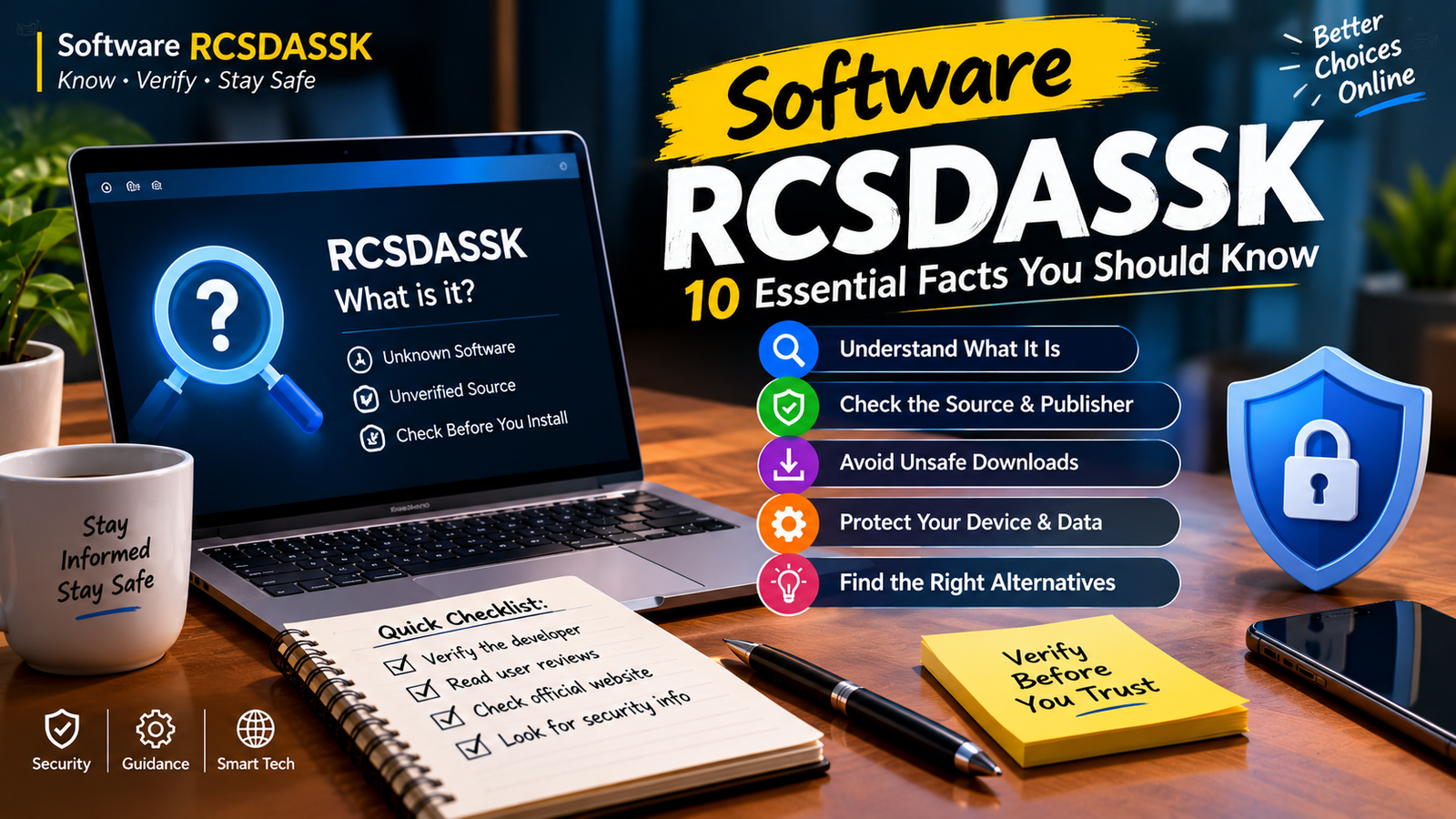
software rcsdassk is an unusual search phrase that appears across technology websites, but its identity is not consistently established. Some pages describe it as a productivity or automation platform, while others connect it with remote access, data management, system errors, or a technical identifier. Those descriptions do not agree, and there is not enough reliable public evidence to treat the name as a confirmed, standardized software product.
That distinction matters. A convincing article, feature list, or download button does not prove that a real application exists behind a name. This guide takes a careful approach to software rcsdassk: it explains what can currently be established, why online descriptions differ, how to investigate the term if it appears on your device, and what to check before trusting unfamiliar software.
The goal is not to dismiss a term simply because it is unfamiliar. Private tools, internal company applications, test builds, and project codenames may have little public documentation. Instead, readers should match claims to evidence and avoid installing files until the publisher and source are verified.
1. What Is Software RCSDASSK?
The most accurate description of software rcsdassk is that it is an ambiguous software-related term with no consistently verified public identity as a mainstream application. A number of websites publish explanations, but the descriptions vary considerably. Some present it as a business automation solution; others describe it as a developer utility, remote-control system, security tool, or general productivity concept.
Readers researching software rcsdassk should begin with evidence rather than assumptions. That distinction is central to understanding software rcsdassk responsibly.
A genuine software product normally has an identifiable developer or company, an official website, documentation, version information, system requirements, a licensing model, and a trusted distribution method. Those details have not been consistently established for this name in the public sources reviewed for this article.
This does not prove that no private project or internal tool has ever used the label. It means readers should not assume that all websites using the same term are describing one product. When researching software rcsdassk, treat claims about features, pricing, compatibility, and downloads as unverified unless they can be connected to a clearly identified publisher.
2. Why Are Online Descriptions So Different?
Search results sometimes contain several articles about an unfamiliar term before reliable documentation exists. Once a phrase begins appearing in search suggestions or web pages, other publishers may create content around it. If those writers rely on one another rather than primary evidence, different explanations can quickly circulate.
For software rcsdassk, online descriptions mention automation, analytics, workflow management, remote access, coding, and security. These are broad technology categories, not proof that a particular application provides those capabilities. Some pages even offer different expansions of the letters, with no recognized specification confirming one official meaning.
Any explanation of software rcsdassk should identify its source and supporting documentation. Treat software rcsdassk as an unverified label until a publisher confirms its identity.
This is a useful reminder that search visibility and factual verification are not the same thing. A term can have multiple search results without representing a released product. Readers should look for independent confirmation rather than treating repeated claims as proof.
3. What Evidence Should a Real Software Product Have?
Before trusting any unfamiliar application, look for evidence that connects the name to a real developer and a maintained product. The following checks are useful:
- Official publisher: Is there a company or developer that clearly accepts responsibility for the software?
- Product documentation: Are there user guides, technical specifications, and support instructions?
- Version history: Are release dates, version numbers, and change logs available?
- Distribution source: Is the installer hosted by the publisher or a recognized app store?
- Pricing and licence terms: Are costs, trial conditions, and usage rights explained?
- Independent coverage: Are there credible reviews or reports that are not simply repeating the same claims?
- Support channel: Can users contact an identifiable support team?
Do not infer capabilities for software rcsdassk from generic technology descriptions. Claims about software rcsdassk need independent confirmation before they guide a purchase.
A trustworthy review of software rcsdassk would include screenshots, version details, and a named developer. Without those details, software rcsdassk should not be treated as a proven business solution.
When these details are missing, the name should remain an unverified term rather than being described as a fully established platform. A page with polished graphics or confident marketing language is not a substitute for verifiable documentation.
Read more: How to Fix SusBlueZilla Code: 10 Powerful Troubleshooting Methods
4. Is It Safe to Download or Install?
There is no verified official download source established for software rcsdassk in the sources reviewed here. Therefore, readers should not download an installer merely because a blog post, advertisement, pop-up, or social media message offers one.
An unknown installer may be harmless, but it could also contain unwanted programs, adware, spyware, or malware. The risk becomes greater if a download page pressures visitors to act quickly, asks them to disable antivirus protection, requests payment before explaining the product, or provides no publisher information.
If you encounter a file using this name, do not open it until you understand where it came from. Check the complete download address, publisher details, file properties, and security warnings. If the source cannot be verified, the safest choice is not to install it.
Searching software rcsdassk is only the beginning of a verification process. Repeated mentions of software rcsdassk do not establish that an official product exists.
For general guidance on safer software downloads and device protection, consult the CISA Secure Our World guidance. The key principle is simple: verify the source before trusting a file with access to your computer or data.
5. What If the Name Appears in a File, Process, or Error Message?
Sometimes an unfamiliar string appears in a file name, browser message, system log, task list, or error dialog. That does not automatically mean it is an application you should install. It may be an internal identifier, a temporary name, a project label, a typo, or a string generated by another program.
If software rcsdassk appears on your computer, note exactly where you saw it. Record the full message, the file path if one is shown, the application that was open, and what happened immediately beforehand. Avoid deleting files or ending processes simply because their names look unfamiliar.
On Windows, you can inspect a file’s Properties to review its location and available publisher or digital-signature information. In Task Manager, use the file-location option where available to investigate the process. Do not assume that a familiar-looking icon proves the file is legitimate. If the item is on a work computer, ask the organization’s IT administrator before changing or removing it.
If software rcsdassk appears in a download prompt, verify the domain before clicking. Never provide credentials to a page that uses software rcsdassk as an unexplained reason for access.
Keep any software rcsdassk installer quarantined until its origin has been checked. Security software can help inspect a file associated with software rcsdassk, but it cannot replace source verification.
6. How to Investigate the Term Step by Step
A calm investigation is more useful than trying random fixes. Use this sequence if you encounter the term in a message, download, or device:
- Identify the context. Determine whether the term appeared on a website, in an email, inside an application, or in a system log.
- Capture the exact wording. Save a screenshot or write down the complete message, including any file path or separate error number.
- Find the source. If it is a file, check where it was downloaded from. If it is a process, inspect its location and publisher information.
- Look for primary documentation. Search for a developer’s official website, support pages, release notes, and a verified download channel.
- Compare independent sources. Check whether reputable sources describe the same product and features, rather than copying identical claims.
- Scan suspicious files. Use updated security software and follow its warnings. Do not run a file simply to see what happens.
- Ask the responsible team. If the term appeared at work or in a managed system, ask IT or the software owner what it refers to.
Document where software rcsdassk appeared so that a technician can investigate the context. An IT administrator may recognize software rcsdassk as an internal project name or identifier.
Do not remove a system file merely because its name contains software rcsdassk. These steps help separate a real internal tool from an unsupported online description. They also reduce the chance of installing something unsafe while trying to discover what the name means.
7. What to Do If You Need Similar Software
Some people search for software rcsdassk because they need a particular capability, such as automating repetitive tasks, managing projects, organizing data, or controlling access to business systems. If that is your goal, search for the capability itself instead of relying on an unverified product name.
For workflow automation, compare tools that publish clear documentation and explain which tasks they can automate. For project management, look for task assignment, calendars, reporting, permissions, and collaboration features. For remote access, investigate security controls, multi-factor authentication, audit logs, and the provider’s support policy. For data management, review export options, backup practices, access permissions, and privacy terms.
A suitable alternative should match the actual problem, not simply have a similar-sounding name. Compare pricing, supported devices, training requirements, and the effort needed to move away from the tool later. A free trial can be useful, but only when it comes from a verified publisher and its terms are clear.
Before adopting software rcsdassk for work, request vendor and security documentation. Businesses should not place customer data into a service identified only as software rcsdassk.
8. Protect Personal and Business Information
Do not enter passwords, payment information, customer records, or confidential business files into an unfamiliar platform. Before any organization adopts new software, someone responsible for IT or security should review the vendor, data handling practices, access controls, and contractual terms.
For individual users, use unique passwords and multi-factor authentication where supported. Keep operating systems and security software updated, and maintain backups of important files. If a suspicious installer has already been run, disconnect from sensitive accounts if appropriate, run a full security scan, and seek qualified technical help if warnings or unusual activity continue.
The NIST Cybersecurity for Small Business resource offers practical security guidance for organizations evaluating technology and protecting information. These general safeguards are useful regardless of whether a particular software name turns out to be legitimate.
Look for a real support channel before trusting claims about software rcsdassk. An honest article about software rcsdassk should clearly separate facts from speculation.
9. Common Claims That Need Careful Verification
When researching an unfamiliar product, be cautious of statements that sound impressive but lack specifics. Claims that an application uses artificial intelligence, automates every workflow, provides enterprise-grade security, or works on all devices should be supported by documentation and demonstrations.
For software rcsdassk, feature descriptions found on different websites are inconsistent. One article may describe a business platform, another a developer tool, and another a remote-access utility. Without an identified publisher and technical documentation, none of those descriptions should be presented as confirmed features.
Look for practical evidence: screenshots from an official product, a detailed user manual, a changelog, supported operating systems, transparent pricing, and a support channel. If a page only repeats broad phrases such as “next-generation technology” or “complete digital transformation,” it has not established what the software actually does.
Any future claims about software rcsdassk should be checked against primary documentation. Until then, describe software rcsdassk accurately as an unverified software-related term.
Read more: What is 1.5f8-p1uzt? Meaning, Uses, Applications & Full Guide Explained
10. Frequently Asked Questions
Is software rcsdassk a confirmed commercial product?
The public information reviewed for this article does not establish one consistently documented commercial product under this name. Treat detailed product claims as unverified until an identifiable developer provides reliable documentation.
What does RCSDASSK stand for?
There is no single independently verified expansion established in the sources reviewed. Different websites offer different interpretations, so none should be treated as an official definition without confirmation from the developer.
Can I download it safely?
No verified official download source was established during this research. Avoid installers offered by unknown websites, advertisements, or unsolicited messages.
Is the term a virus?
The term alone does not prove that a file or process is malicious. Equally, the name does not prove that a file is safe. Investigate the actual file, source, location, publisher, and security scan results.
Why do websites describe it differently?
Some articles appear to infer features from the name or repeat claims without primary documentation. Different descriptions are a reason to verify the product rather than assume that one explanation is correct.
What should I do if my workplace mentions it?
Ask the IT team or software owner for the official vendor, purpose, approved download source, and security review. Do not install a workplace tool based only on an unfamiliar name in a message.
Conclusion: Verify Before You Trust Unfamiliar Software
An unusual software name can create curiosity, especially when search results present several confident but conflicting explanations. The most responsible approach is to separate what is documented from what is merely claimed.
At present, software rcsdassk does not have a consistently verified public identity as a mainstream software product in the sources reviewed for this guide. That does not rule out a private project or internal identifier, but it does mean readers should not assume there is an official application, confirmed feature set, or safe download.
Check the source, identify the developer, look for real documentation, and protect your device and data before installing unfamiliar files. If you need a particular software capability, research established tools by function and compare their verified features. Careful verification is more valuable than trusting a name simply because it appears repeatedly online.